Polaris Marble
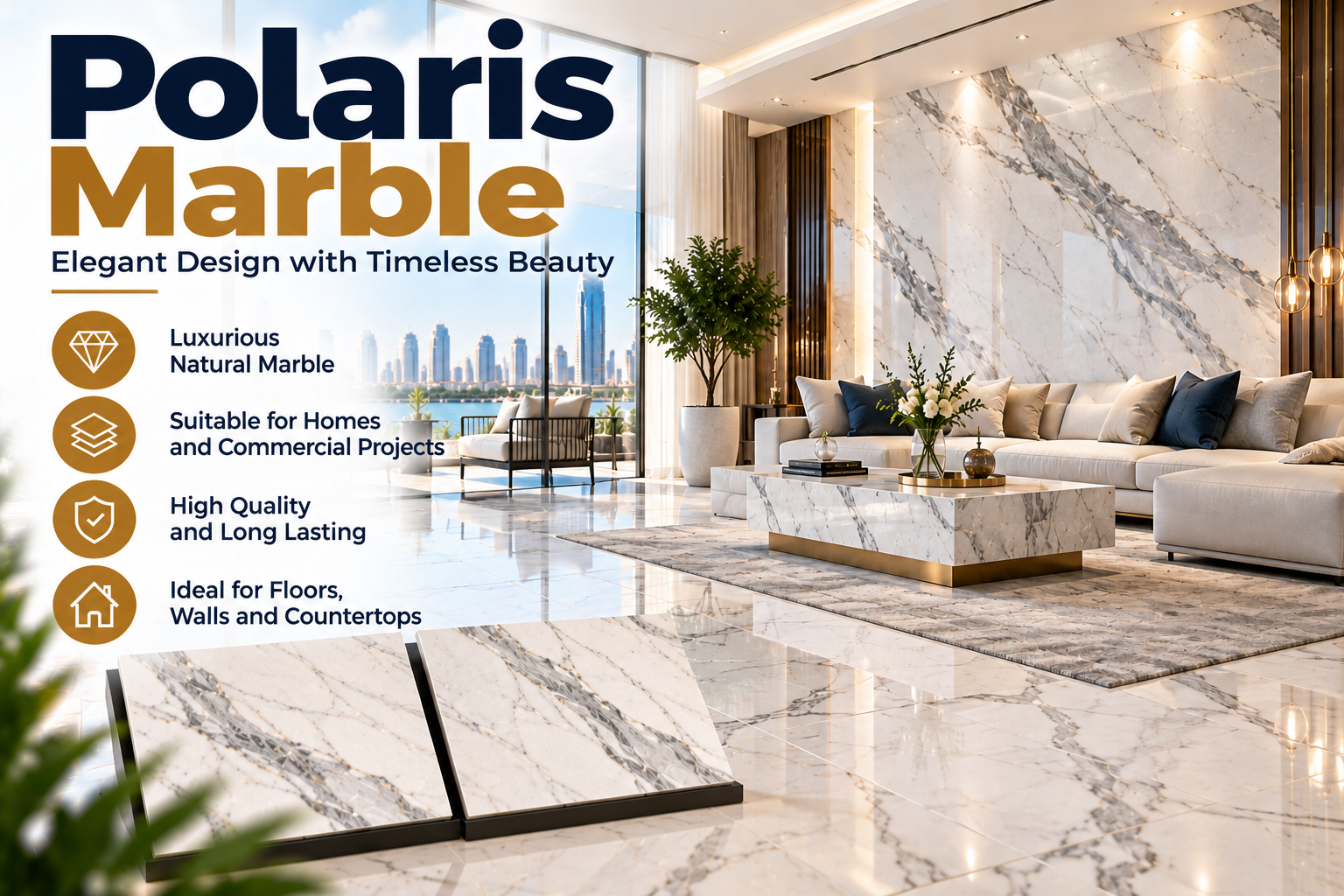
Polaris Marble is a distinctive natural white marble valued for its bright appearance, fine crystalline character, and subtle grey or light-beige natural movement. It can create a clean and elegant architectural finish for villas, luxury residences, hotels, offices, reception areas, bathrooms, staircases, floors, and feature walls.
For UAE homeowners, architects, interior designers, contractors, and project buyers, Polaris can be considered when a project requires a sophisticated white natural-stone appearance. Because commercial Polaris materials can vary by origin, selection, shade, veining, dimensions, and finish, buyers should inspect the actual slabs and verify the country of origin before ordering.
What Is Polaris Marble?
Polaris is a natural marble generally recognized by its white to creamy-white background and delicate natural veining.
Depending on the particular quarry, commercial selection, and slab, its appearance can range from relatively clean white surfaces to material with visible grey, silver, or light-beige movement.
Technical documentation for one Polaris source identifies the material as dolomitic marble, while Greek marble suppliers also market Polaris selections with white or light-beige backgrounds.
This means the commercial name alone should not replace proper material verification.
What Does Polaris Marble Look Like?
The visual character of the stone is generally refined rather than heavily dramatic.
Typical characteristics can include:
White or creamy-white background
Fine crystalline appearance
Soft grey veining
Light-beige movement
Subtle linear patterns
Natural shade variation
Polished or honed finishes
Every natural slab can vary, so buyers should inspect representative material before approving a project order.
Where Does Polaris Marble Come From?
The commercial name Polaris can be associated with material from different quarrying sources.
Technical documentation exists for Polaris marble originating from Prilep in North Macedonia, while Greek natural-stone companies also offer Polaris marble from Greece.
Therefore, when purchasing Polaris Marble, ask the supplier to provide the declared country of origin, quarry or block information where available, commercial selection, and actual slabs included in the quotation.
This is particularly important for architects, contractors, and customers who need a specific origin for project documentation.
Polaris Marble Slabs
Full slabs provide the best opportunity to understand the natural appearance of the material.
When inspecting slabs, compare:
Background whiteness
Grey or beige movement
Vein intensity
Vein direction
Crystalline appearance
Natural markings
Dimensions
Thickness
Surface finish
For projects requiring several slabs, view the available material together whenever possible.
Polaris White Marble
White Polaris selections are particularly suitable for design concepts where a bright and understated natural-stone appearance is preferred.
The white background can coordinate with:
Timber
Neutral furniture
Dark cabinetry
Metallic details
Glass
Contemporary lighting
Beige interiors
Grey interiors
The final appearance depends heavily on the actual slab selection and surrounding materials.
Polaris Marble Flooring
Polaris Marble can be considered for suitable interior flooring applications where its technical characteristics and finish meet the project requirements.
Potential applications include:
For larger flooring projects, review shade consistency and natural variation across the complete quantity before installation.
Polaris Marble for Villas
White natural marble can create a bright architectural foundation for contemporary and classic villas.
Polaris may be considered for suitable areas such as entrance halls, living spaces, majlis rooms, staircases, feature walls, and selected bathroom applications.
For complete villa projects, compare the stone with doors, cabinetry, timber, furniture, lighting, wall colors, and other flooring materials before confirming the final selection.
Polaris Marble for Majlis Areas
A light marble floor can complement many majlis design styles.
Its predominantly white appearance can work alongside carpets, warm timber, decorative wall finishes, neutral furniture, and metallic accents.
For large majlis spaces, check that sufficient material with an appropriate visual relationship is available for the complete floor.
Polaris Marble for Staircases
Natural marble can provide an elegant finish for staircases when the selected material and specifications are appropriate for the project.
Before ordering, consider:
Accurate staircase measurements or drawings can help fabricators calculate the required pieces.
Polaris Marble for Walls
The clean appearance of Polaris Marble can make it suitable for selected architectural wall applications.
Potential uses include:
Feature walls
Entrance walls
Reception areas
Bathroom walls
Vanity surrounds
Decorative panels
Large slabs can display the natural crystalline structure and subtle movement more clearly than small samples.
For vertical installations, dimensions, weight, substrate conditions, fixing systems, and professional installation requirements should be evaluated.
Polaris Marble for Bathrooms
Selected Polaris stone may be considered for suitable bathroom applications.
Its light appearance can complement contemporary bathroom designs, timber vanities, metallic fittings, neutral surfaces, and minimalist interiors.
For wet areas, confirm that the selected material, finish, substrate, installation system, and maintenance plan are appropriate for the intended location.
Polished Polaris Marble
A polished finish can emphasize the stone’s crystalline appearance, background color, and natural movement.
It may create a more reflective and visually bright surface.
However, finish selection should not be based on appearance alone. The intended application and relevant technical requirements should also be considered.
Honed Polaris Marble
Honed material provides a different visual character from polished stone.
Depending on supplier availability, buyers may compare polished and honed samples before deciding which appearance works better with the project’s design.
Always confirm the exact finish in the supplier quotation.
Polaris Marble Technical Characteristics
Technical properties should be checked against the documentation for the actual stone source and batch being considered.
For example, published technical data for one POLARIS material from Prilep, North Macedonia identifies it as dolomitic marble and reports an apparent density of 2,840 kg/m³ and water absorption of 0.2% by weight.
These values should not automatically be assumed to apply to every product sold commercially under the Polaris name.
Request the relevant technical data sheet for the actual material being purchased.
Polaris Marble vs Volakas Marble
Polaris and Volakas can both be considered when a project calls for light natural marble, but they should not be treated as identical materials.
Volakas is strongly associated with the Drama region of northern Greece and commonly features visible natural veining.
Polaris selections can offer a cleaner crystalline appearance with relatively subtle movement, depending on the particular source and slab.
Compare full-size slabs rather than deciding from product names alone.
Polaris Marble vs Carrara Marble
Carrara is an Italian marble family associated with the Carrara region of Tuscany.
Polaris is a different commercial stone selection.
Although both can provide a white or light marble aesthetic, their crystalline appearance, veining, origin, selection, and individual slab characteristics can differ.
The right choice depends on the actual material and project requirements.
Natural Variation
Natural marble does not have a perfectly repeated manufactured pattern.
Individual pieces can vary in:
Background shade
Vein intensity
Vein direction
Crystal appearance
Natural markings
Pattern distribution
A small sample should therefore not be expected to represent every slab.
For large projects, inspect the available material before cutting and fabrication begin.
Polaris Marble Care and Maintenance
Proper cleaning is important for preserving natural stone.
The Natural Stone Institute recommends understanding the geological classification and composition of a stone before choosing cleaning products. Its care guidance recommends neutral cleaners, stone soap, or suitable mild cleaning methods and cautions against inappropriate acidic cleaners for acid-sensitive natural stone.
For additional professional information, consult the Natural Stone Institute Care & Cleaning Guide.
Always follow recommendations appropriate to the actual stone and finish installed in the project.
What to Check Before Buying Polaris Marble
Before purchasing Polaris Marble, verify:
Declared country of origin
Quarry or source information where available
Commercial stone selection
Actual slab appearance
Background color
Veining and natural movement
Dimensions
Thickness
Surface finish
Technical data
Intended application
Required quantity
Fabrication requirements
Current availability
For large villa, hospitality, or commercial projects, confirm sufficient material before fabrication begins.
Polaris Marble Price
There is no single universal price for Polaris stone.
The final quotation can depend on:
For an accurate comparison, ask different suppliers to quote equivalent specifications.
Where to Buy Polaris Marble in UAE
Customers looking for Polaris Marble in the UAE can compare natural-stone suppliers serving Abu Dhabi, Dubai, Sharjah, Ajman, Al Ain, and other Emirates.
Before placing an order, inspect actual slabs or representative samples and verify the origin, stone selection, dimensions, thickness, finish, technical information, quantities, fabrication requirements, and available stock.
For larger orders, obtaining a detailed quotation based on the complete project requirements is preferable to comparing only a general square-meter rate.
Conclusion
Polaris Marble offers a bright natural-stone appearance characterized by white to creamy backgrounds, crystalline texture, and generally subtle grey or beige movement. Depending on the specific source, selection, technical characteristics, and project requirements, it can be considered for suitable floors, villas, majlis areas, staircases, bathrooms, feature walls, reception areas, hotels, and commercial interiors.
Because Polaris is a commercial name that can be associated with different origins, buyers should verify the actual stone source, inspect the slabs, review technical documentation, compare specifications, and confirm sufficient matching material before purchasing.