Rectified vs Non-Rectified Porcelain Tiles: Complete Comparison and Buying Guide
Introduction
Choosing the right porcelain flooring involves more than selecting colors, patterns, and dimensions. Understanding Rectified vs Non-Rectified Porcelain Tiles is equally important because tile edges affect grout spacing, installation requirements, and the final appearance of a floor.
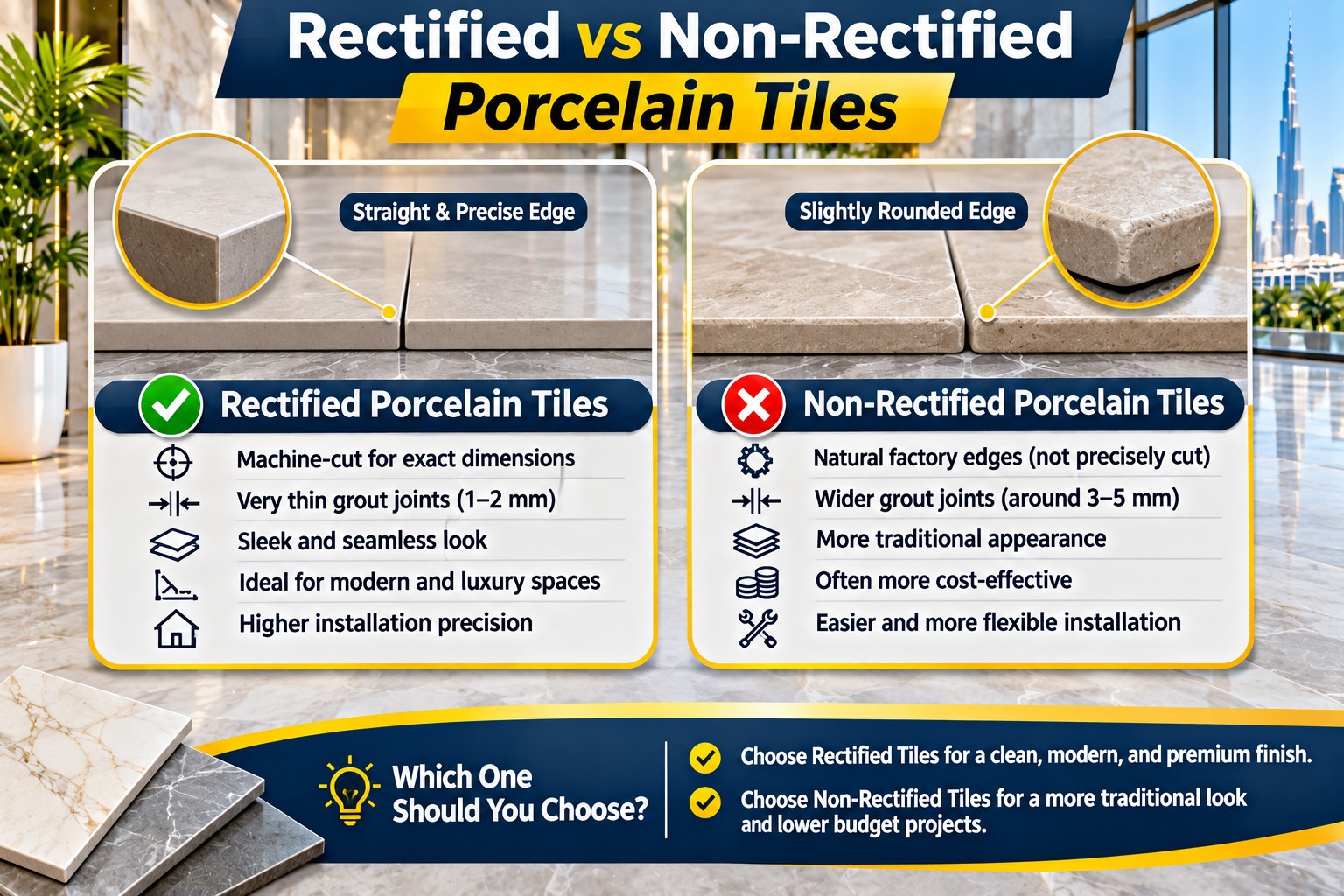
When comparing Rectified vs Non-Rectified Porcelain Tiles, the main difference is how their edges are finished after manufacturing. Rectified tiles have mechanically trimmed edges and precise dimensions, while non-rectified tiles retain their original pressed edges, which are usually slightly rounded.
Both options offer attractive designs and practical benefits. However, knowing the differences between Rectified vs Non-Rectified Porcelain Tiles helps homeowners, architects, and contractors select the right material for villas, apartments, hotels, and commercial interiors.
What Are Rectified Porcelain Tiles?
Rectified porcelain tiles undergo an additional mechanical process after firing. Their edges are ground or cut to achieve consistent dimensions and straight, square corners.
This manufacturing process makes rectified tiles suitable for designs that require a clean, uniform appearance. When considering Rectified vs Non-Rectified Porcelain Tiles, rectified options are particularly popular in modern villas, large living rooms, hotel lobbies, and contemporary commercial spaces.
Main benefits include:
Accurate and consistent tile dimensions.
Straight edges and square corners.
Narrower grout joints when permitted by the manufacturer.
Clean and modern flooring designs.
Excellent options for large-format porcelain collections.
What Are Non-Rectified Porcelain Tiles?
Non-rectified porcelain tiles retain their original pressed edges after firing. These edges are generally slightly rounded, and minor dimensional variations may occur within the manufacturer’s specifications.
Unlike rectified options, non-rectified tiles usually require wider grout joints. In the comparison of Rectified vs Non-Rectified Porcelain Tiles, this type is often suitable for traditional, rustic, and decorative interiors.
Main benefits include:
Natural-looking, slightly rounded edges.
Wider grout joints that accommodate dimensional variations.
Suitable for traditional and decorative designs.
Often available at a more economical price.
Practical choices for residential flooring projects.
Rectified vs Non-Rectified Porcelain Tiles: Key Differences
Understanding Rectified vs Non-Rectified Porcelain Tiles makes it easier to compare their appearance, installation, and practical performance.
| Feature | Rectified Porcelain | Non-Rectified Porcelain |
|---|
| Edge shape | Straight and square | Slightly rounded |
| Dimensions | More precise | Minor variations |
| Grout joints | Narrower | Wider |
| Appearance | Modern and uniform | Traditional and natural |
| Installation | Requires greater precision | More forgiving |
| Cost | May be higher | Often more economical |
The choice between Rectified vs Non-Rectified Porcelain Tiles should depend on the desired design, tile specifications, installation conditions, and project budget.
Grout Joints and Installation Requirements
Grout spacing is one of the most important considerations when comparing Rectified vs Non-Rectified Porcelain Tiles. Rectified porcelain can accommodate narrower grout joints, depending on the manufacturer’s recommendations and applicable installation standards.
Non-rectified porcelain generally needs wider joints to accommodate variations in tile dimensions. However, rectified tiles should never be installed without grout gaps. Proper spacing is essential for a successful installation.
Professional installation is particularly important when using rectified porcelain. Uneven substrates, inconsistent adhesive coverage, and poor alignment can create visible differences in tile height.
For technical guidance, explore Atlas Concorde’s Tile FAQ and MSI’s guide to rectified and non-rectified porcelain tiles.
Which Porcelain Tiles Are Best for Your Project?
When choosing between Rectified vs Non-Rectified Porcelain Tiles, consider the architectural style and practical requirements of your space.
Rectified porcelain is an excellent choice for modern villas, large-format flooring, hotel reception areas, and commercial interiors where a uniform appearance is preferred.
Non-rectified porcelain works well in traditional homes, decorative spaces, and projects where wider grout joints complement the overall design.
Before purchasing, compare actual samples, dimensions, thickness, surface finish, color, and manufacturer specifications. These details help ensure that your selected porcelain tiles are suitable for the intended floor or wall application.
Explore different tile options through Savan Store to find designs suitable for residential and commercial projects.
How to Choose Between Rectified and Non-Rectified Porcelain Tiles
The right decision when comparing Rectified vs Non-Rectified Porcelain Tiles depends on several factors:
Design: Choose rectified edges for a more uniform appearance or non-rectified edges for a softer traditional look.
Grout width: Consider the joint width recommended for your selected tiles.
Budget: Compare the total material and installation costs.
Tile dimensions: Check dimensional consistency, especially for large-format tiles.
Installation: Make sure the installer follows the manufacturer’s instructions.
Application: Confirm that the tile is suitable for the intended floor or wall.
Samples: Inspect the actual product before ordering.
Comparing Rectified vs Non-Rectified Porcelain Tiles before purchasing can help prevent installation problems and ensure a consistent final result.
Conclusion
The comparison of Rectified vs Non-Rectified Porcelain Tiles shows that both options offer valuable benefits. Rectified porcelain provides precise edges and a modern appearance, while non-rectified porcelain offers softer edges and a traditional finish.
There is no universally better option. The best choice depends on your design preferences, budget, grout requirements, and installation conditions. Understanding Rectified vs Non-Rectified Porcelain Tiles before purchasing helps you make a practical decision and achieve attractive, durable flooring.